Wednesday, February 19, 2020

Are refugees the solution to Japan’s aging problem?

After spending years studying Japan and Japanese, I at first found it difficult to reconcile investing so much time in a developed, safe country with my other professional goals, mainly in the human rights and crisis arena. Then, it hit me: Japan has an incredibly low refugee acceptance rate and a very high demand for young workers. Refugees tend to be young, so what if refugees could solve Japan's labor problem and Japan could solve refugees' danger problem?

I became interested in this question a long time ago. I brought it up in my JET Programme interview, to the Harvard Kennedy School when trying to justify working there for a year before starting school, and to just about every person I met in Japan (after establishing a rapport). After a year in Japan and a long time concerned with refugees, here's what I found.

What's the problem?

Japan is an aging society. Longevity and low birth rates have led to a much larger ratio of people relying upon government benefits to people working to pay for them; benefits programs have doubled as a share of GDP in the last 30 years alone. On top of this, Japan has a huge debt burden. Prime Minister Shinzo Abe's proposed economic solution, raising the consumption tax from 8 to 10%, has so far done more harm than good.

What Japan needs to do is increase production--a very simple way to do this is by adding people to the workforce. Japan's aforementioned low birth rate means this will have to be foreigners. This is where refugees come in.

Amnesty International says there are currently 22 million refugees. On top of this, 10% of refugees need to be resettled every year because of outbreaks of violence, insecurity, or xenophobia. More than 80% of refugees today are hosted in developing nations despite the fact that developed nations, like Japan, have a far greater capacity to host refugees.

In Japan's case, there is even a huge need for people. Right now, foreign workers make up 2% of Japan's labor force. For most developed countries, this number is around 10%. In the US, the world's largest economy, that number is above 17%.

What is Japanese immigration like now?

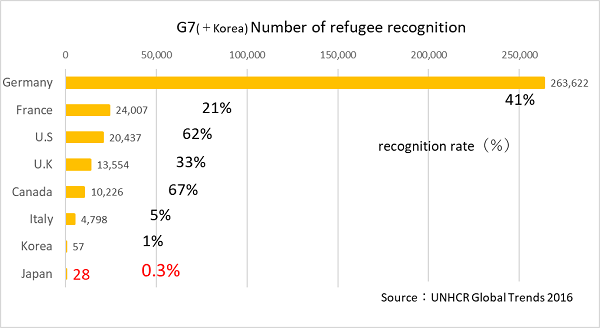
Complicated. But hey, at least the whole country isn't closed off to the outside world anymore. In 2017, Japan received 20,000 applications for asylum and accepted 20. At the height of the Syrian refugee crises, Japan accepted just 7 Syrian refugees (from 2011 to 2016). In 2018, the number of accepted refugees doubled to 42, though compared to the 16,269 people who were deported the same year, this change is kinda insignificant. What is also interesting is that the number of applicants also dropped by half--to around 10,000--in 2018. Why is that?

The reason is that Japan's refugee/asylum system has long served as a back channel for those hoping to immigrate to or work in Japan. Many economic migrants applied for asylum to take advantage of the 6 month work privilege. "Filipinos accounted for a quarter of the applicants. Conflict zones in the Middle East and Africa — Syria, Afghanistan, Congo, Iraq, Yemen, and South Sudan are some of the usual countries UNHCR expects to see — accounted for only 1%." This was not intended. Japan cracked down in 2018, but did not fully solve the problem.

Another complication is the human rights abuses in the migrant labor system in Japan. The main culprit is the Technical Intern Training Program (TITP), which allows unskilled 'interns' to come to Japan and work. However, "While some interns aren't taught any skills, others experience forced labor conditions including having their passports confiscated, being given arbitrary salary deductions, being confined to particular accommodations, being prevented from communicating with anyone beyond their colleagues, with some paying up to $10,000 to participate in the program.” Essentially, this is how Japan uses and abuses cheap labor without a functional immigration system. There are 230,000 people in the program today.

There are more problems with this system, like the extremely narrow definition of a refugee Japan uses, the racism/xenophobia, the years and years of wait times, or the abysmal treatment of migrants, but I believe these are the main barriers affecting the system at a large scale.

What could the system be like?

While there is still a huge unmet global need, there are some good examples that could provide a model for Japan. Canada is the current world leader for sheer numbers and many countries have raised their quotas in recent years. On top of this, there are times when Japan itself was a model to follow. In the wake of the Vietnam war, Japan took in more than 10,000 refugees who fled from Vietnam, Laos, and Cambodia.

However, even if Japan suddenly overcame the massive popular hesitation around foreigners and refugees, the numbers would not be spectacularly high. As alluded to above, very few applications in the refugee system actually come from people in need worldwide. There are three main reasons for this: lack of social networks (migrants tend to go where their friends and family have gone), unfavorable labor laws (see 過労死 karoshi), and Japan's intentional barriers to entry such as a mandatory 6 to 9 month orientation course. In short, without a campaign to raise application rates to Japan, estimates range from 50 to 2,000 people would come as refugees each year. Though the high end is more refugees than Japan has accepted since singing the UN Refugee Convention in 1981, it is not nearly enough to make up for Japan's labor shortages.

Conclusion

Refugees alone will not solve Japan's aging problem. That's because there just aren't enough of them. However, each additional refugee admitted to Japan will be a life greatly improved and a step towards addressing the labor shortage; it's still a win-win to accept more refugees. This raises the question, what will solve this problem?

One suggestion is to expand the immigration system more generally to accept migrants of all types. Of course, this should be done in a much different way than the abusive system that exists now. However, some estimate that even expanding and reforming this program would only be a drop in the bucket. A major overhaul would be needed to the sheer numbers needed to properly address the labor shortage. This means sweeping liberalization of the system and massive increase in support throughout society.

But what if the problem is not labor shortage at all? Of course, the aging of the population is certainly one half of the equation, but the other half is declining birth rates. On reason for this decline is the pressure Japanese society puts on young people and women. Japan has some of the longest working hours in the world and many problems surrounding contractual employment that inhibit young people's ability to start families. Japan ranks 161st out of 193 countries in female political representation. Women in Japan make up just 13 percent of managerial positions (compared to 44% in the US). Socially, harassment of working mothers is so common it has its own word (マタハラ matahara from 'maternity harassment') and women are sometimes forced to apologize for becoming pregnant out of order (senior women go at more convenient times). Every country has its problems and the Japanese labor problem is certainly complex, but I believe it is reasonable to hypothesize that reducing barriers for young families and fully utilizing the potential of women could huge positive effect on this and other problems.

At the risk of further complicating the issue, I have to admit that my own experience in Japan does not fully confirm the data and research above (specifically this survey). Though there was certainly a lot of apprehension and concern for safety and crime, almost every Japanese person I talked to thought that Japan could and should do a better job of accepting refugees--especially after we talked for a while. There was a genuine, widespread sense of international duty and a willingness to do the right thing. True, it may be easier to give your true opinion to a Japanese surveyor than an actual foreigner in the flesh. Another interpretation is that, maybe, this is a larger conversation that, once enough people have had it, could move Japan in the direction of accepting more refugees.

Saturday, February 01, 2020

Book Review 2019

There are a number of my experiences from 2019 I am still trying to understand: finishing a year teaching Elementary School in rural Japan, moving back to America, my first semester of graduate school... In the meantime, I think I would like to share some more episodic influential moments of the past year. I read some very good books.

Ok, ok, that may not be as unique or exciting, but the changes 2019 brought played out in a noticeable way here and the framework of one book and one time is much easier to break down for now.

A perfect storm of having more flexibility, better organization, and less required reading in Japan revitalized my love for reading, to which I am thankful. What I discovered is that, when I pick the books, they can be incredibly transformative. Scrolling through social media or keeping up with the news can provide a lot of information, but having a thoughtful, well-organized idea that has room to develop is unparalleled.

I am still excited to use this platform to share my experiences some ideas of my own, but I want to get the ideas these books gave me down while it is still timely. Plus, a ton of people have been asking me for citations from these books or recommendations in general, so two birds (sorry PETA).


5: Modern China, A Very Short Introduction - Rana Mitter


Increasingly, I find China in the news with shockingly little context for its national history or culture. From the 'economic miracle' to the questions of social credit and surveillance, it always seemed like stories and events were presented as if they came out of nowhere. As someone with only a cursory familiarity of China, I felt it necessary to take the first step in correcting this.

What followed was a bit of a research binge. I highlighted, took notes, and researched something on almost every page. This book is incredibly dense yet remains an easy and quick read. As with every book in the Oxford VSI series (of which I have read about two dozen by now--amazing), reading this will get you to the level of understanding the basics of what is going on with China and how it got there, but with serious limitations. If you'd like to know enough to have a conversation about an issue pertaining to China, that would probably deserve its own time and effort outside this book.

All-in-all I recommend this to anyone who has found themselves curious about China and who wants a place to start. I've loaned the book out multiple times to friends from China and those just interested (it is still away at the time of writing) and it always starts some great conversations.


4: Winners Take All - Anand Giridharadas 


This is probably my most quoted book of 2019. What's better is that I even got to see him talk at (and subsequently eviscerate) the Kennedy school less than a month after reading this book. For anyone who hasn't listened to a podcast or watched Patriot Act with Hasan Minhaj, this book takes aim at the plutocrat class. The thesis is that millionaires and billionaires avoid paying their fair share in taxes and redeem the social capital by making a show of their comparatively minor philanthropy.

Of course, there are many problems with this. First, a small group of people are controlling huge amounts of resources in various public-good-oriented spheres--and their biases can have devastating effects. Second, to paraphrase Anand when he sat in the John F. Kennedy Forum at Harvard, we now have a situation where the wolves are guarding the sheep pen; the people in charge of change in our society are the very people who have the most to lose from the type of change that will actually make a difference. Most important is the strong and persuasive pushback against the idea that private enterprise is the best instrument of positive social change. Instead, Anand champions government and democracy.
Anand speaking to a full house, though unfortunately at the same time as Mark Cuban (some of the people who went should have been here)

If any of this piqued your interest, I highly recommend picking it up at your local library. I find many of his arguments compelling, but the particular way in which he phrases them is exceptionally entertaining and clever. My one critique is the irony of his chapters on thought leaders and work at places like McKinsey. If you read it and read about his recent work, I think you'll understand what I mean.


3: How to Hide an Empire - Daniel Immerwahr 


Easily the best-written book I read in 2016 is this. The book covers the lesser known or intentionally hidden history of America's expansion and control over land outside the continental U.S. Although we often decry oppression and empire (and in fact mythologize our creation in defiance of these terrors), there is evidence that the United States is the largest empire the world has ever known.

The book breaks down many ways in which this is true. First is the most obvious conceptualization of empire: territory and oppression. Chilling examples of this are the horrific expansions into the Philippines and Hawai'i. Not only did this expansion require intense violence (including, arguably, the perfection of the concentration camp), but also intense dehumanization. This campaign was so widespread that when Pearl Harbor happened, President Franklin D. Roosevelt was not sure the American people would care enough about their rights-less 'compatriots' in the Philippines, Guam, Alaska and Hawai'i to go to war. He chose to focus on the territory with the highest white population, Hawai'i, to make the best case for retaliation. This fact may explain why many, including myself, did not know the attacks on December 7/8th occurred outside Hawai'i at all. This is one of many awful revelations about American territory in the book.

On top of territory, the US also maintains an empire through language, culture, and military presence overseas--and these are all linked. Ever wonder why so many foreign people seem to be learning English? Ever thought why Jazz is so popular in Japan and Rock was so big in the UK? Ever surprised to hear US soldiers were attacked in Africa? If so, definitely check this book out.


2: How Europe Underdeveloped Africa - Walter Rodney


Speaking of hidden history, Walter Rodney has done some very heavy lifting documenting and countering the massive systemic obscurities in the Western narrative of World History, especially pertaining to Africa. The book starts by correcting some very troublesome misconceptions about what Africa was like before European contact. In short: much the same, often better, but just without the fancy boats. Most African kingdoms were not interested in European goods, instead preferring to trade internally. This forced European traders to bring goods from Asia and, later, the New World which started the snowball information advantage.

From then on, Europeans (and later the people in their colonies) began to exploit Africa's resources and sabotage its development. In fact, the title seeks not to explain the lack of development in Africa but rather to show 'underdevelopment' as a verb--something Europe did to Africa intentionally.

The most troublesome effect of reading this book is how frustrating this perspective is for conversations about aid and development. Seeing development as something that happens over time is not only ignorant of different histories, values, and cosmovisions, but also obscures the past and present violence maintaining the system. Changing a few numbers around on a national budget plan is not going to correct for centuries of plunder and a rigged global system. If any of this was new to you (as much of it was for me), consider this book essential.


Honorable mentions:

  「質問です。」- 名越 康文, Rape During Civil War - Dara Cohen

「質問です。」, meaning something like "the questions" in English, is simultaneously a self-help and a self-discovery book. While I personally did not find many of the questions to be relevant (not exactly in the target audience I presume), I did find the organization of the book particularly well-suited for use getting to know people or staging a moment of self-reflection. Thus, I have had a great deal of fun with the book, but cannot bring myself to recommend it outside a very small group of people.

Dara Cohen's book is exactly what it sounds. The writing is clear, the organization is impeccable, and the subject matter is truly brutal. Particularly shocking was the fact that much of the research in this book and a lot of research on similar topics is that it borrows on research of US fraternities. That's not a typo. Literally the closest analogue to the sexual atrocities committed in armed conflict is what's happening on US college campuses. It's among the most disturbing and hard-to-read-in-public books I've experienced, but incredibly fascinating and informative.


1: The Divide by Jason Hickel


If you're looking for a book that will change the way you see the world, look no further. This is a shocking indictment that captures the best (or, I guess, worst) parts of the books by Walter Rodney, Daniel Immerwahr, and Anand Giridharadas. It then goes further, dismantling how the system we think promotes world peace and prosperity may in fact be a carefully misleading cherry-picking of statistics designed to obscure suffering and promote an unsustainable lifestyle.

For example, it is impossible to avoid hearing about how innovations or the work of non-profits have reduced things like world hunger or poverty. It is even harder to not believe what they say--the consensus is broad and non-ideological. However, many of the definitions of these terms are not evidence-based but rather based on what measures fit the narrative; world hunger is only decreasing if you only count people living on less than 1,000 calories a day (potentially less than a third of what is needed for a lifestyle of manual labor) for an entire year. Poverty is only decreasing if you use a number somewhere around $1-2 a day, but experts say the amount of money you make does not have a measurable impact on quality of life until you make around $7 a day or more. The number of people making less than $7 a day has been increasing for as long as it has been measured. Even the best case scenario of the UN's sustainable development goals sees this number continuing to increase as a success (the UN uses a lower number and uses percentages instead of counts).

Once you get past the manipulation problem, there is also the problem of how to fix the problems we already have. Our global governance institutions--the UN, World Bank, WTO, etc.--are all intentionally biased in favor of the United States and other wealthy nations. How can we expect them to fix the problems of big nations having too much power when they were designed to maintain this system?

There is much more breadth and depth (as well as solutions) in the book. Definitely go read it.


Summary


Each of these books really helped to change one aspect of how I saw the world. I believe their coming at a time of intense change in my own life made me much more receptive to the challenge and created an even greater sense of urgency in my present trajectory. I am grateful for a lot that has happened this year, but most of all I am thankful for the opportunity to learn and apply my values to a complex world. Writing this helped me realize that change is good. In fact, it might be the only thing that can save us. 


Wednesday, February 06, 2019

6 in, 6 left

As of today, I am approximately halfway done with my post here in Niigata, Japan. I have learned a whole lot–too much for one post certainly–but I also hope to learn much more with my remaining time. It is this latter thought that has kept me from more frequent updates. With every new thing I learn in Japan, I discover two or three more that I did not even know existed previously. I would feel guilty presenting a view that is neither entertaining for its bewilderment nor informative for its expertise, so I have just been waiting.

That being said, this checkpoint felt like a good point to fill in some of the gaps for anyone who may be wondering what's going on with me and my life. Without further ado, here's a glorified highlight reel from 6 months in Japan.

In reverse chronological order:

Karaoke

In a sea of black-haired people, this blonde fellow with a bun felt like he was stealing my style
Karaoke is one of Japan's favorite pastimes. Although it has some popularity overseas, I haven't had much experience before coming here. Though I've had a wide range of experiences depending on the crowd, I can definitely recommend belting out a few dozen songs if you ever get the chance, the older the better. Depending on the location and price range, the Karaoke location could have features like bottomless drinks, food, light shows and more.

Also pictured is Katakana English, those symbols above the English writing intended to teach Japanese-speakers how to pronounce the lyrics phonetically...ish. Its inclusion is necessary and understandable, but this is the bane of any English teacher's existence in Japan. For example, this passage reads: Ai kudo bii yua wan ando onrii / Ai kudo meiku yuu unronrii ravu ravu. A lot to undo there. Anyway...

Music


From what I have seen so far, Japanese culture gets music right in most areas. All of my elementary schoolers carry around a recorder and a melodica and many learn other instruments outside of school. I recently went to a Jazz festival and the band pictured, the Niigata city junior orchestra, was made up of middle and elementary schoolers who can knock your socks off. Jazz improvisation is still a tall order for me after a decade of playing the guitar, yet it seemed natural to the 10-year-old on the sax. Mad props.

I say "mostly" in reference to any shopping experience you will have in Japan. For some reason unknown to me, any convenience store, shopping center, or grocery store seems to only have access to terrible midi versions of American songs popular before I was born. Often, there is just one song, about three minutes long, stuck on an infinite loop. That's one way to prevent loitering, I guess.

Mascots


Mascots are a big deal in Japan. Prefectures, cities, towns, companies, they are everywhere. Some of them are even worth billions of dollars, no joke. Some have theme parks, some have merchandise, some have theme songs, sometimes they feel inescapable... but they are very cute. Not to brag, but I have personally met the Bandai City mascot and Gudetama. 

Architecture

Seeing my own breath indoors (5˚C)
There have of course been books written about the intricacies of Japanese architecture and how the culture surrounding buildings here differs to the West. I am not going to talk about any of that; what I am here to do is complain about my cold apartment. For one reason or another, central heating is very rare and most buildings prefer to heat only the rooms being used. This means I come home from work each day to a room that is somehow even colder than the outside temperature. I have found myself too wimpy to cook on more than one occasion (too cheap to heat more than one room) and sometimes wear 3-4 layers indoors. Plus side: no need to have a fridge for a few months a year.

KFC for Christmas


It's true. Legend has it two foreigners were spotted eating at KFC one Christmas evening in the 80s, allegedly trying to emulate a turkey feast as best as the cultural gap would allow. Today, there are lines across the block at KFC and buckets upon buckets of fried chicken filling the grocery stores every year. It is considered by some to be an American tradition and many are surprised to learn Americans genuinely see no connection between the restaurant and the holiday. 

The bro came


Immediately before heading off to his first semester of university, my younger brother and I had a lighting fast tour across Japan. We spent a couple days in my home prefecture of Niigata, where we went to a Soba festival and ate some okonomiyaki. Then, we headed to Osaka, Nara, Kyoto, and Tokyo to see some sights and hear some sounds. Not nearly enough time, but we still wandered into some pretty interesting locations, like not one but two Bathing Ape stores. I can genuinely say that was my first time being priced out of buying socks.


Hello Kitty land


Nothing I has convinced me more that the apocalypse is inevitable than this theme park. The characters are too powerful. Hello Kitty is a billionaire and her reach exceeds that of presidents and dignitaries across decades.

Old friends new places

Train ride in Osaka with Diandra and another JET from her area, Laura
Another trip that was far too short, but very exciting! This was the most symmetrical meetup of my life. For those who don't know, Diandra and I met in our very first college class: Japanese 101. Neither of us knew if we would ever come to Japan and here we are, 4 years and some change later. If you're reading, thanks again for hosting me :)

Autumn tints (紅葉)


One of my favorite Japanese words turned into one of my favorite Japanese events. Each fall, what seems like the entire Japanese countryside turns into a tourist attraction (mainly domestic). Although I do not have a great picture on hand, it is still easy to see why. I am on the edge of my seat waiting for the cherry blossoms to arrive in the Spring.

Driving is weird


Yes, that's a rugby game on my car's TV. Why this is possible in a country so concerned with safety I am not sure. I tend to stay away from any distractions when driving, but I have explored a bit and it turns out I actually get more channels on my car's TV than the one in my apartment.

Driving is interesting in other ways here, but I actually do plan to elaborate with a separate post soon.

School lunch (給食)

Japanese-style curry: no heat and very sweet.
Because I work in elementary schools, I get to experience the delight that is kyuushoku or school lunch. This is a really interesting concept that I really admire, but I want to save an in-depth discussion for its own post as well. Basically, every class eats lunch together–including the same food. The students help prepare and set up the lunch every day and clean up afterwards. I am invited to a random classroom every day and get to talk to the students for a few minutes if I can understand what on earth they are trying to say with all that rice in their mouth. The food is always very tasty, healthy, and cheap as well!

Owari~

Bandi City Mascot. Told you
That's about it for now. As I gain confidence in my ability to tell the story right, I hope to share more about life in Japan. I have a lot to be thankful for and I look forward to everything I will learn in these next 6 months. 


Saturday, December 29, 2018

Duolingo 101: Everything you need to know!

One of the many benefits of learning another language: more sweets! (Also a preview of a Blog to come)


***Scroll down for the tutorial!***


With each language comes its bias
With the New Year approaching, I thought I would do my best to enable as many people as possible to find success with their language endeavors and resolutions! Thus, here is my all-encompassing guide to using Duolingo (and a bit of other resources) to learn a language!

For some background, I have now finished four courses on Duolingo: Japanese, Spanish, French and Dutch. I already had background knowledge exceeding the first two and I took French 101 at university concurrently with starting the French course. Dutch was the only language I learned exclusively through Duolingo. The French course took me 11 months and Dutch about two years. Over that time I have also flirted with the Czech course before a weekend in Prague and am currently working on the Hindi, Swahili and Mandarin courses.

In this post I will also draw upon my experience learning languages in other settings such as work, travel, one-on-one exchange partners, university and high school to give the best advice I can about how to succeed in learning a language and how to use Duolingo to help that process. Though the courses I have taken cover many continents and language families, keep in mind my advice could be less accurate for languages I have not tried.


In the following guide, I will explain what Duolingo is and what exactly it has to offer. Then, I will teach you how to use Duolingo properly as it can be a bit unintuitive and has many hidden features. Finally, I will give my opinions and recommendations. Let's go!

Note: different features are available on different platforms and even among individuals, so beware. The website is the most similar for everyone and can be accessed through your phone's web browser.
The email campaigns can get quite... intense, lending itself to many memes


Imagine the possibilities with this one

What is Duolingo?

Duolingo is a free(ish) language learning platform that comprises a website and applications on all major platforms. I say -ish because you truly pay for Duolingo with either a paid premium subscriptions or through ads that run after each lesson in the costless version.

Duolingo offers 87 languages courses including 3 constructed languages, but if you're reading this as an English-speaker then you have about 34 real options. Some of those 34 are in Beta, meaning they may not have all the features of the completed courses, contain bugs and are much shorter. In order of popularity are:
  • Spanish
  • French
  • German
  • Japanese
  • Italian
  • Korean
  • Chinese (Mandarin)
  • Russian
  • Portuguese
  • Turkish
  • Dutch
  • Swedish
  • Greek
  • Irish
  • Hebrew
  • Polish
  • Norwegian (Bokmål)
  • High Valyrian (from Game of Thrones)
  • Vietnamese
  • Danish
  • Romanian
  • Swahili
  • Hindi
  • Klingon (from Star Wars)
  • Swahili
  • Esperanto (constructed international auxiliary language) 
  • Hungarian
  • Welsch
  • Ukrainian
  • Czech
  • Hawaiian (Beta)
  • Indonesian (Beta)
  • Navajo (Beta)
  • Arabic (not yet available, ETA May 2019)
And if you speak Spanish, you can also learn:
  • Guaraní
  • Catalan
See anything you like?

What you might not know about Duolingo is that it also has active forum, words, lab, story, and podcast sections. I will discuss more about these sections and how to use them in the next section.


How do you use Duolingo?

First, you create an account and choose your target language. If you have previous experience with the language, you can utilize the placement test and test-out features to reach an appropriate level. From there, we need to learn about bubbles and crowns wait what?


In the above photo are five bubbles, each containing a 'skill' full of individual lessons. Each lesson takes a few minutes to complete and each skill has anywhere from two to nine lessons on the first go around. After you complete the skill, you will get a 'crown' and the bubble will turn from the purple shade you see above to the blue shade and a crown icon will appear in the corner. For each 'crown' you can redo the skill with more lessons and harder questions for a maximum of 5 crowns. This is a good, but not great (more on that in the next section), visual representation of how well the skills are embedded into your mind. To unlock more skills, you have to complete all the skills you currently have available to at least the first crown level.

Questions

Within each lesson are a variety of questions which become more or less frequent depending on your crown level and, frustratingly, the platform you are using. Also, the most important thing to know is that YOU ARE NOT SUPPOSED TO KNOW THE YELLOW WORDS. Click or tap on them to learn. If you assume you are supposed to answer the questions as is, like I did at first, you will lose your mind.

Anyway, here are the different types of questions you will encounter ranked, in my opinion, from best to work in terms of developing skill are:

Word unscramble translations

I don't like these because they focus your eyes on text in your native language and do not require anything more than a basic understanding of the sentence and a good understanding of word order in your native language.


Multiple choice

These are better because they focus your attention on text in the target language, but still fall short for me because they are easy and by design contain two incorrect sentences you must read for every correct sentence. These are much better when they ask you the correct conjugation out of all possible conjugations (all of which are correct but innappropriate), but these only show up in certain versions.


Unscrambling audio dictation

If the blocks are in the target language, this gets a pass from me because spelling and understanding speech are skills that can be developed separately, but I still prefer typing out and do not support the idea of staring at words in your target language and moving them around.


Translating into/from target language

Good. 

Keep in mind, however, that translating and learning a language are two very different skills and one should focus more on understanding, especially as languages are farther linguistically from your native language.


Character-based questions

These also exist, and some are better than others, but I don't want to spend much time on them since most languages on Duolingo don't use them and only Chinese and Japanese will continue to use them after the beginning of the course.


Speaking

Yessss! Sometimes a bit off on recognition, but it will let you through if you keep trying. I believe this feature is only available on mobile or for limited languages, which is unfortunate. However, speaking is really a skill that should be developed with a partner. I will develop upon these opinions in the next section.


Rote audio dictation in target language

The perfect lesson for the role Duolingo plays in language learning, especially because it gives you a translation at the end. This engages your knowledge of the language, spelling, and exposes you to the sounds and flow of the language, the key to success.


Pro tip: you can often manually disable the disaster that is the unscramble option by clicking the "show keyboard option." Unfortunately it seems this feature is not available on all platforms.

This so far has covered what you will see in the skills bubbles. You can also click the 'practice' button, represented by a dumbbell in the bottom right corner on mobile, to enter a pseudo-SRS (spaced repetition system) review of a skill randomly selected based upon your activity on the app. This is essential to long term learning unless you go back and review religiously. On the website, there is an even better feature:

Here you see two practice options. I left choice is almost identical to practicing with the bubbles. The right side is an amazing, gameshow-esque timed quiz where you start with 00:30 seconds and gain time with correct answers. The practice ends when you run out of time or answer 20 questions (right and wrong combined). This is by far the best feature as it mimics real life scenarios and help you to overcome what I call the tip-of-the-tongue problem that develops with too much solitary or reading-based practice.

Test-out and Tips

These are by far the most important features on Duolingo. At the moment, they are fully available on the website and partially rolled out on most languages. You can access them from clicking or tapping on the bubble and not immediately selecting the practice feature.

Tips

These are grammar explanations or further information that make up for the weaknesses of Duolingo's game-like instruction system. These range in quality from a few sentences clearing things up to extensive grammar tables and explanations that rival a textbook. These are essential to using Duolingo to learn a language.


Test-out

This allows you to skip a crown level with a simple test. Get four questions wrong and you get nothing! Unless you're using this to get to an appropriate level given your background knowledge, you have to be careful with this feature as Duolingo's weaknesses can allow you to develop a false sense of ability through these. This is different from the keys in between the bubbles which let you skip entire sections of the course with a similar testing layout.

Course management


You can add as many languages as you desire at any time both on web and mobile. Though many language learners have intense opinions about learning multiple languages at once, I know through personal experience it is at the very least possible both in theory and on Duolingo. You can also remove languages you no longer want to study or reset your progress on courses you either want to give a fresh start to for any reason. This can be accessed in the settings tab on the website and on some other platforms.

XP goals

This has to do with your 'daily streak' and is evaluated based upon how much practice you do. One lesson is almost always 10xp, for scale. I will discuss my opinions and recommendations on using this system to your advantage in the next section.

Emails/reminders

You can change the time they appear each day or turn them off via the settings tab on the website.


My recommendations 

Duolingo is a fantastic resource, especially given the price. unfortunately, it is not going to single-handedly get you from zero to fluent. Further, even at the beginner stages of your Duolingo course it would be enormously beneficial to supplement your language learning with other resources or specific strategies that may not be intuitive. In this section, I will provide some of those strategies and resources and will touch upon differences depending on which language you are learning.

Don't use Duolingo how it wants you to use it, aim for better understanding than the questions demand

The mission statement of Duolingo is to make language learning fun and free, not effective. That doesn't mean it you can't add that in with a bit of modification to the default strategy. After all, no one can be taught a second language; one learns a second language. Here are some tips.

These can be hard and will take a lot of getting used to, but will improve your skills much faster and much more effectively. To do this, I recommend adding the following rules to you use, at least from time to time.

Never use the unscramble optionLike I said above, it focuses your attention on what you already know and will teach you to cheat instead of use your target language.

Close your eyes and listen to the sentences being spoken first, even if it's not an audio question

This will help your comprehension. If you can, try to answer the question without reading it. When you read, you are allowed to take more time and may recognize words based on similarity to your native language. Just listening is harder and will make you better. Plus, if you can't get it you always have the option of answering the questions normally afterwards.


The 'hovering technique'

Ok in all honesty I stole this photo from Duolingo's Instagram because my current strategy is a little different, but this is still very effective. This strategy both looks nice and helps you use spaced repetition in your learning, the most effective way of adding things like vocabulary and grammar to your long-term memory. I mentioned that the practice feature is a pseudo-SRS earlier, so let me explain that here. This is not a true SRS because it does not take into account feedback such as how easy or hard the questions were and tests you based upon your activity on the app, not your knowledge. Other apps, which I recommend below, are much better at this. The hover method makes up for the flawed SRS and also prevents you from steamrolling a bunch of new material while forgetting everything else.

Use timed practice

If you want to say you can "speak" a language, you will probably have to speak, right? This feature is the best preparation for that, even more so than the speaking practice. Why? Because the speaking practice makes you read a script. The timed practice makes you think on your feet, sink or swim, and moves all that language knowledge from the dusty recesses of the back of your mind straight to the front, where you can use it easily.

Look up grammar independently

If you read the tips (or if they don't exist) and still don't get it, it won't get better. Search the name of the skill and language and something should come up!

Consistency over intensity

The most important thing about learning a language is that you practice every day. That is why my XP goal is always 10 per day, even though I do almost 300 each day on average now. Having a low goal means you have no excuse for making time to practice every day. In reality, you will often want to do more after your goal, meaning there is no benefit to a high XP goal other than a higher chance you will lose your streak and motivation.

Clubs, friends and forums

Clubs and forums will help you with questions and hold you somewhat accountable, especially if you are competitive and find a group of like-minded language learners. Further, if you add your friends, they will all be able to see how much you have practiced each week and month. 

Outside resources

These are crucial to your longterm success in a language both during and especially after you finish your Duolingo course. In some cases, depending on your target language, you might be better off or forced to use a different app, which I will recommend here.

Translation

No matter what language you are learning, you need an offline dictionary app, period. Don't settle for a laggy online app or a phrasebook as your primary 'help me I don't understand' solution. This is especially important if you live somewhere or are visiting where your target language is spoken. Google Translate online is good for if you do not need perfection or for longer phrases and even sentences. You can also download a language for offline use and some languages allow picture translations (though this won't help you learn). There are some amazing browser extensions that let you read foreign text quite easily through automatic word or sentence translations. I have specific apps for certain languages in the apps list below.

The news

If you are learning a non-European language as a native English speaker, I don't want to get your hoped up. Just go to the next section. For all of you still around, this can be a great way to get timely, native exposure to a language. A beginner or intermediate learner will get much more out of the news than TV shows for reasons I will touch upon below. The potential problems include advanced or specific vocabulary and cultural references, neither of which you will see in places designed to teach.

Specific applications and browser extensions 

Checklist for any language:
  • Anki
    • Best SRS in the game
    • Many study decks already in existence 
  • Offline dictionary
  • Rememberry
    • Chrome extension 
    • Automatic translations
    • Option to save vocabulary into an SRS deck
Alternatives to Duolingo
  • Beelingua
    • Allows you to hear and read text karaoke style
    • Free
    • If you're intermediate, you can learn two language at once this way (I do Spanish and Japanese)
  • Lingodeer
    • Paid alternative to Duolingo. 
    • Limited language selection
    • Much better for Asian languages (I use this for Mandarin and for reviewing Japanese). 
    • The activities and features are much better, but alas there is a paywall.
  • Mango languages
    • Has far more languages (around 70 compared to Duolingo's 37), including some very rare courses to learn as a second language like Bengali and Igbo. 
    • This is also a paid app, and a pretty expensive on at that, but may be free for you if you are a member of some libraries
  • Ling
    • More languages that Duolingo doesn't have, such as Thai, but not offline and has a paywall after a few lessons
Language-specific

Japanese
  • Rikaikun chrome extension
    • Automatically provides reading and translation for Kanji
  • Takoboto
    • Offline dictionary #1
    • Has a powerful Kanji compound search feature
  • Japanese
    • Bad name, good app 
    • Offline dictionary #2
    • Has a weak SRS
    • Better for conjugations and short phrases
    • Ability to access limited decks
  • Kanji Study
    • Invaluable. By far most powerful language resource
    • Kanji broken down by JLPT level, grade and more
    • Built-in dictionary
    • Allows you to practice writing characters
  • JLPT
    • Pretty self-explanatory if you know what this test is
Mandarin
  • Lingodeer
    • See above
  • Pleco
    • Offline dictionary
  • HSK #
    • Characters, tone practice etc. by HSK level (I have HSK 2)
  • Lingodeer supplementary material by HSK level


Final thoughts

Learning a language is one of if not the single most beneficial hobby you can start this new year if you have not already. Being bilingual has extraordinary benefits in terms of cognitive function, disease prevention, memory, employment opportunities, and most of all culture. Though I hope this posts helps, ultimately learning a language is something that's completely up to you. If you need someone to annoy you and keep you on the right path, let me know and I will definitely do so!

Good luck!
¡Buena suerte!
頑張って下さい!
Veel succes!
Bonne chance!
祝好运!
Bahati njema!
सौभाग्य!

(Google-sensei helped me with those last three)

Friday, October 12, 2018

Come on baby, America!

Month two has come to a close and I certainly have a lot of interesting experiences and cultural discoveries to talk about! Instead of doing that, though, I thought I would share a bizarre story about America's reach overseas and influence and... OK it's a story about how funny the elementary schoolers are.

So there's this song... I highly recommend checking this out with English subtitles. It's hilarious:
https://www.youtube.com/watch?v=sr--GVIoluU
The song responsible, 91 million views and all
I came to Japan expecting to be preceded by countless expectations, stereotypes, and terrible news cycles about my *official* home country, America (the use of the word official here is a whole story in itself, but for later). To an extent this has been true, but dramatically less so than in New Zealand, where my classmates would ask why I wasn't fat and if I could locate the United States on a map without missing a beat. In my experience so far, the Japanese tend to be much more apathetic about world politics and the nuances of America's behaviors. Nowhere is this more true than in elementary school. 

Now to set the stage, I have to give a short 自己紹介 (jikoshoukai/self-introduction) to every class where I explain my background and answer some questions. One of my favorite parts of getting to know new classes is having them guess things about my identity. Why?

モーガン先生、何歳ですか?何歳と思いますか?ええ…65歳?
Morgan-sensei, how old are you? How old do you think I am? Hmm... 65?

And so on. I've had students guess I was from Africa, ask if I was married to their homeroom teacher, think I spoke only German, ask what my job was... seriously, what do you think I'm doing right now? Even funnier is what they extrapolate from the information I give.

ああ、22歳!お母さんは24歳!子供が何人がいる?
Oh, 22! My mom is 24! How many children do you have? 

I guess there really isn't much to do in this town... Anyway, the thing that confused me most was that the first thing every first, second, and third-grade class did when I said "America" was burst out into a co-ordinated chant and throw their thumbs behind their heads. Without fail. They would also periodically remember I said America later in the class and get started all over again. This is made even more funny by the "U-S-A" chant at the beginning of the song which invariably comes up when teaching the alphabet. It's inescapable. What's more, this funny song has completely replaced any other information these kids have about the United States. 

In most countries I've been to, kids have at least a vague idea about what kind of things happen in America and what things in their country are from America. In Japan, however, me claiming hot dogs, burgers, and pizza are popular in America was met with disbelief and laughter. No American celebrity names could ring a bell. Even using my best Japanese to ask questions doesn't extract any information out of the younger students.

Is there a deeper meaning to all of this? Probably not–they thought I was 65, after all.


Monday, September 03, 2018

Japan

After nearly a month in Japan, I've finally got the chance to write down and share some of the thoughts from my first month here. This not even close to all of the incredible and interesting experiences I've had so far, but I hope to share those in separate posts in the coming weeks. Here's the highlights of my first 29 days in a form similar to a Q&A!


Why Japan?

Fully explaining this requires its own post, but the short version is as follows: on a whim, I decided to enroll in Japanese 101 the day before my first day of university. Even though it was at times my most challenging class, I stuck to it and found a way to use my Japanese while staying on track with my ultimate goal of pursuing an MPP in International Relations. Now, I'm with the Japanese Exchange Teaching (JET) program teaching English in three elementary schools in Niigata prefecture. I arrived to Tokyo August 5th and to Niigata prefecture on the 9th (after orientation). My first day at school was this past Monday, August 27th!


What are you doing?

On a daily basis, I get up, tuck my futon away into the closet of my tatami apartment, drive my tiny EK-Wagon named 「フロゾン」 to school on the left side of the road, and co-teach English classes. For the first couple weeks this is mainly me explaining my background, sharing a few things about North Carolina, and playing some folk music on my guitar. Although I've played and performed for 10 years now, I think this is the most I have ever played for an audience. In case you're curious, this is the song I've played dozens of times now, but since they can't understand the lyrics I've made it a bit more cheerful.

The name of my city, Gosen, in Japanese

I've quickly learned the 35/hrs a week in my contract is actually a very funny joke and thus have not had much free time outside of work, errands, cooking and exercise. I hope to flush out this section a bit more once I get more into the swing of things.


Wait... car? Apartment? What's your living situation?

Since I have a new position and thus have no predecessor as is typical for JET participants, I arrived to an empty tatami-style apartment in the oldest building in town. It quite literally did not have anything in it (not even toilet paper!) from the previous inhabitant, so I have been busy buying pans and towels and all sorts of things you never realized you need starting from scratch. Additionally, the building itself has very little insulation, meaning temperatures in the 90s (mid- to high-30s in celsius) in my apartment (and freezing temperatures to come in Winter). After almost three full weeks of nearly endless trips to the ¥100 store, I have a pretty comfortable arrangement, including two fans and and AC unit pointed at me at all times.

The car is as typically Japanese as they come. Left-hand drive, box-like, motorcycle-sized engine and quite literally the smallest possible car where I can fit my knees under the steering wheel. I am sure it is just as funny watching me climb in and out of the car as you are imagining. Unfortunately, the car is essential to my work and my days of high-horsedly walking everywhere are finished. 


Fresh, pre-made meals like this will usually run you about $4 US or less
Accurate depiction of me driving

How's Japan?

It's amazing. I will go into more depth about expectations versus reality very soon, but for now I can say it is everything it is said to be. Here's a quick bullet journaling:
  • The sushi is delicious and far cheaper
  • Doorways are lower and I hit my head a lot
  • Anime, manga and karaoke are as wildly popular as they seem
  • 7eleven is a gift from the Gods
  • Cash is used almost exclusively
  • People do flash their blinkers as a thank-you for merging while driving
  • Chopsticks are dominant and napkins are nonexistant
  • Sitting on the floor and no shoes at restaurants is very common
  • Respect and kindness are unparalleled
  • I have to go to the plus-sized store for pants and shoes
  • Fruits are a delicacy 
Now I don't live in Tokyo, so urban Japan is not something I see often. Rural Japan, referred to as the 'inaka' 「田舎」has its own completely different societal structure in countless ways. Again, this is something I plan on flushing out soon!

How's school?

Ahh, back to grade school. I have been lucky enough to receive an exceptionally hospitable welcome at every school so far. From 'oohs' and 'aahs' at my fumbling Japanese self-introductions to a school of 500 singing me happy birthday, it has been heartwarming and exciting. The school style is also completely different in a way I really enjoy. Some differences I've noted include:
  • Again, shoes off (bring some indoor shoes instead)
  • Very open rooms and bright hallways
  • Eating lunch with the students in their room (self-served and cleaned)
  • Students come to the staff room to get teachers (happens to me more as an assistant teacher)
  • A lot of fun and games
  • Classes usually stay together for years, so the atmosphere changes wildly by class
  • Tons of calming music and announcements made over the speakers
  • Greeting at the start and end of class
  • Teeth brushing after lunch
Out of respect for my students and co-workers, I will almost certainly not have many pictures from my time here, but I hope to share these experiences in other ways.

Similarities to the Netherlands: canals, clean water, known for Tulips, flat

Fireworks on my second weekend


What have you learned so far?

Luckily, I religiously tracked my study habits and results over the summer, so I can give a bit of quantitative data here. On average, I have been learning about a month's worth of Japanese every week here based upon my results before coming to Japan. One of my favorite things to study are the various Japanese characters. Around the time I graduated from UNC, I knew approximately 850 of them. Now, I know almost 1500. Here are some charts with nice colors and a satisfying upward trend.

Total characters recognized at all confidence levels (few weeks old)

Learning rate over time
My speaking and listening comprehension have skyrocketed, albeit to a fairly intermediate level. I have good confidence navigating any common situation in Japan now, though more complicated interactions are still a struggle (I'll explain your order at a restaurant but couldn't get you out of a ticket). With every milestone my decision to move here seems more correct and my heart more full.
The more of the language I learn, the more of the culture I gain access to. Although I am far from understanding the nuance of most situations, the things I have learned so far have been extremely interesting and have changed my frame of mind in a number of situations. In my best impersonation of a broken record, I hope to expand on this in the coming weeks. Sayonara!